
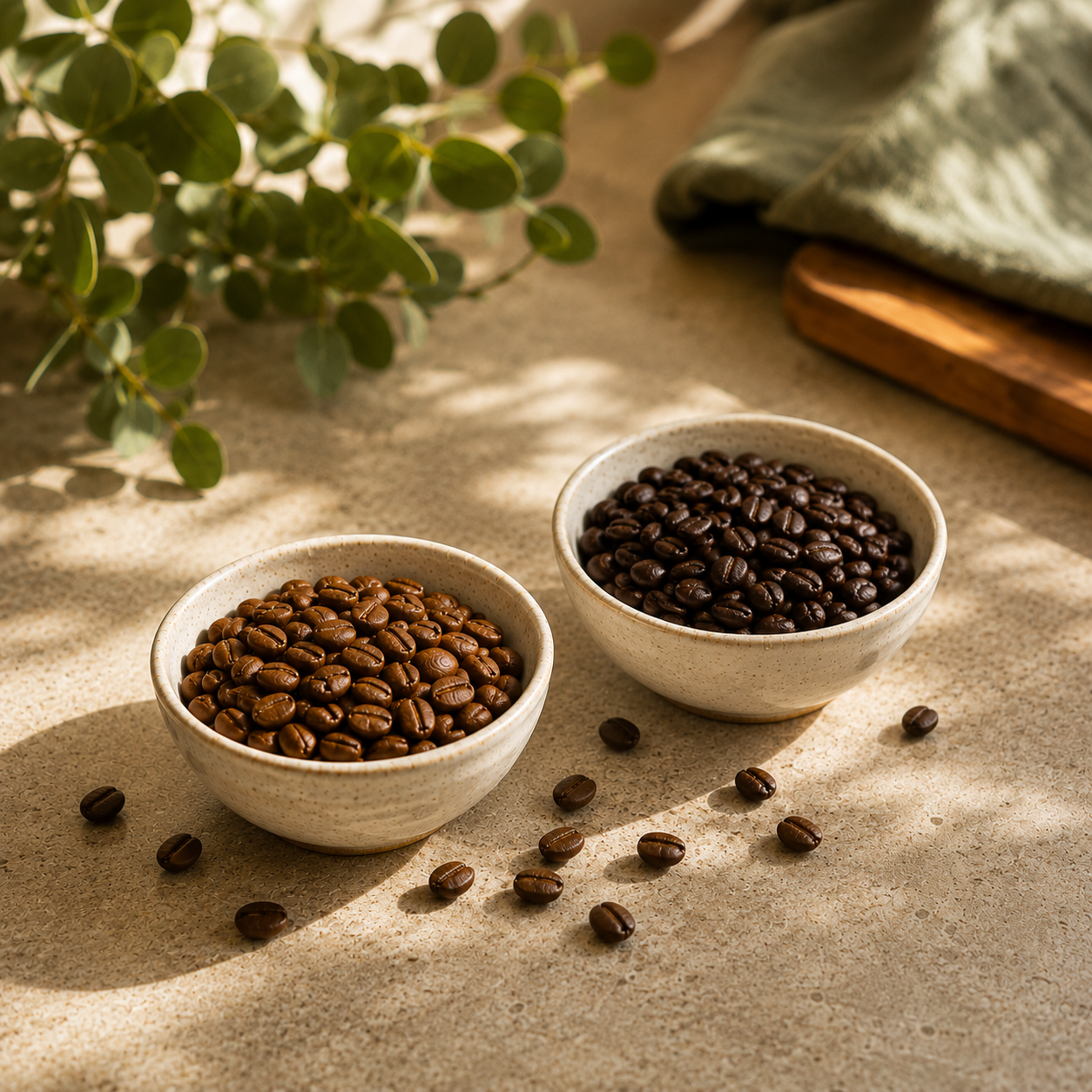
When we started looking more closely at the coffees we sell, one thing became very obvious: roast level tells you far more about a coffee than simply whether it tastes “strong”.
In fact, two coffees can contain exactly the same beans and taste surprisingly different simply because they’ve been roasted differently.
We have a particularly good example of that in our own range. Chapel St and Brunswick St contain the same blend of four coffees. Brunswick St is roasted lighter; Chapel St is roasted darker.
Taste them side by side and you begin to understand what roasting actually does.
So, what are you choosing when you buy a light, medium or dark roast?
Coffee doesn't start out brown
Before roasting, coffee beans are green. They’re the seeds of the coffee cherry, which have been processed and dried ready for the roaster.
Roasting is what transforms those fairly unremarkable-looking green beans into the aromatic brown coffee beans we recognise.
As the beans heat, their chemistry changes. Sweetness, aroma, acidity and flavour develop and change as the roast progresses.
The important bit for us as coffee drinkers is this:
The further the roast develops, the more the roasting process itself influences what we taste.
That's why roast level matters.
What does a light roast taste like?
With a lighter roast, more of the characteristics associated with the coffee's origin and processing remain prominent.
These coffees can be brighter and more aromatic, with flavours that might remind you of fruit, citrus or flowers. They also tend to have more noticeable acidity and a lighter body.
And “acidity” doesn't mean your coffee tastes like vinegar. In coffee language, it describes that bright, lively quality you might recognise in flavours such as citrus or fresh fruit.
Light roast also doesn't mean weak coffee.
That's one of the confusing things about coffee: roast colour and strength aren't the same thing.
If you enjoy discovering the differences between coffees from different origins, lighter roasting can make those distinctions particularly interesting.
What about medium roast?
Medium roast is where a lot of coffee drinkers find their happy place.
There's still plenty of the character of the coffee itself, but roasting has developed more sweetness and body and softened some of the brighter acidity.
You might encounter fruit and citrus alongside flavours such as nuts, caramel and chocolate.
Our Flinders Lane is a good example. It's a medium-roasted blend of coffees from India, Brazil and Colombia, designed to be smooth, rich and balanced rather than particularly light or heavy.
It's the sort of coffee that makes sense when somebody tells us, “I just want a really good, smooth coffee.”
And dark roast?
As coffee is roasted darker, the balance shifts.
Some of the more delicate characteristics of the original beans become less prominent and the flavours developed through roasting become stronger.
The coffee generally tastes bolder and fuller, with less perceived acidity and more of those deep, roasted flavours many of us associate with a traditional strong coffee.
Chocolate, toasted nuts, caramel and spice are common flavour descriptions.
Our Chapel St sits at this end of our range. It's deliberately dark roasted, full-bodied and robust, with the sort of intensity that works particularly well if you like a coffee with plenty of presence.
Here's the interesting bit: Brunswick St vs Chapel St
These two coffees give us a rather neat way of demonstrating roast level because the blend itself doesn't change.
Both contain Colombian, Brazilian and Papua New Guinean Arabica coffees together with 10% Indian Robusta.
The difference is the roast.
Brunswick St is taken to a lighter profile. It retains the body and crema of the blend, but allows more of the character of the individual coffees to show.
Chapel St takes exactly the same blend darker. It becomes bolder and more robust, with a stronger roast character and a more traditional European-style profile.
Nothing has been swapped in or taken out.
Same four coffees. Different roast. Noticeably different result.
If you've ever wondered whether roast level really matters, these are probably the two coffees in our range that demonstrate it best.
Does dark roast have more caffeine?
This is probably the biggest misconception about roast.
People often use dark, strong and high-caffeine as though they mean the same thing.
They don't.
A dark roast can certainly taste stronger because its flavours are deeper and more intense. But that doesn't automatically mean there is more caffeine in your cup.
The species of coffee, the amount of ground coffee you use and the way you prepare it all affect caffeine.
So choose a dark roast because you enjoy that bold flavour — not because you assume it's automatically going to give you a bigger caffeine hit.
What happens when you add milk?
This matters because most of us don't choose coffee purely on how it tastes black.
Milk changes the balance of the cup. A fuller-bodied, more intense coffee can retain more of its character once milk is added, which is one reason darker coffees are popular for flat whites, cappuccinos and lattes.
But there's no rule saying milk requires dark roast.
Our St Kilda Road is a good example of why.
It's a modern blend of Colombian and Brazilian coffees with Indian Robusta, and it was specifically created to work both ways.
With milk, the roaster describes flavours reminiscent of vanilla, milk chocolate, peaches and light stone fruit.
Drink the same coffee as an espresso and you get a creamy texture with dried apricot and candied citrus coming through.
That's not a question of one preparation being better than the other. They're simply bringing out different aspects of the same coffee.
So which roast should you buy?
This is the part where we'd rather not tell you what you're supposed to like.
Coffee gets unnecessarily complicated sometimes.
If you enjoy bright, delicate and fruitier flavours, you'll probably be happier towards the lighter end of the spectrum.
If you like smoothness and balance without too much intensity, start around medium.
If your idea of a great coffee is bold, rich and full-bodied — particularly if you add milk — head darker.
And if you're not sure, try different roast levels. That's a much better way to learn what you like than worrying about whether you're choosing the “right” coffee.
Because there isn't a best roast.
There's the roast that makes the coffee you look forward to drinking.
Share:
5 mistakes people make with reusable coffee pods (and how to fix them)